Complex System Science
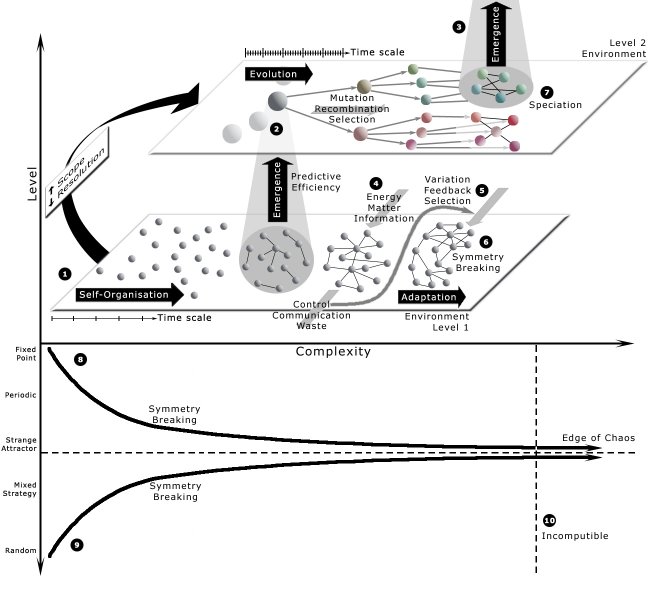 |
A fundamental concept underpinning Complex System Science (CSS) is that local interactions between relatively simple components can lead to considerably more complex non-local behaviours. A fundamental conjecture CSS attempts to study is that these local interactions are the drivers for processes like self-organisation and emergence and, in turn, are responsible for the immense variety of structures, patterns and phenomena we see in Nature. We ask what it means to carry out CSS by computer modelling and what kind of complexity can we study with this approach. We believe these are important questions, given that so much work in CSS is done with the aid of computer modelling and since much of the development of CSS was made possible by the availability of fast computing. In particular we discuss a) if and how computer modelling differs when it is applied to a complex rather than to a non-complex problem, b) what is the role of the modeller in overall complex-problem solving and c) whether common measures of process and model complexity match human perception of the difficulty of solving a 'complex' problem by employing a computer model. |
Definition and measurement of complexity in ecological models and data sets
- Boschetti F., 2010, Detecting behaviours in ecological models. Ecological Complexity, Volume 7(1), pp 76-85, doi:10.1016/j.ecocom.2009.05.014.
- Prokopenko, Harre, Lizier, Boschetti F, Peppas & Kau mand, 2019, Self-referential basis of undecidable dynamics: from The Liar Paradox and The Halting Problem to The Edge of Chaos, Physics of Life Reviews, doi 10.1016/j.plrev.2018.12.003
- Boschetti F., 2007, Mapping the complexity of ecological models, Ecological Complexity, Vol 5/1, pp 37-47, doi:10.1016/j.ecocom.2007.09.002.
- Symons J & Boschetti F, 2012, How Computational Models Predict the Behavior of Complex Systems, Foundations of Science, 18(4), 809-821, 10.1007/s10699-012-9307-6.
- Prokopenko M, F.Boschetti, and Ryan A, 2009, An Information-Theoretic Primer On Complexity, Self-Organisation And Emergence, Complexity, DOI: 10.1002/cplx.20249.Boschetti F., McDonald D., & Gray, R., 2008, Complexity of a modelling exercise: a discussion of the role of computer simulation in Complex System Science, Complexity, 13(6), pp 21-28.
- Boschetti F., 2011, Rationality, complexity and self-organisation, Emergence: Complexity and Organization, 13, 1 & 2, 133-145.
- Boschetti F.& Gray R. 2007, A Turing test for Emergence, in M. Prokopenko (ed.), Advances in Applied Self-organizing Systems, Springer-Verlag, London, UK, 2007 , pp 349-364.
- Batten D, Salthe S & F.Boschetti, 2008, Visions of Evolution: Self-organization proposes what natural selection disposes, Biological Theory, Vol. 3, No. 1, Pages 17-29.
Emergence: understanding, modelling and formal description
- Boschetti F., 2010, Causality, emergence, computation and unreasonable expectations, Synthese, 181, 405–412, 10.1007/s11229-010-9720-8.
- Boschetti F. & Symons J, 2011, Novel properties generated by interacting computational systems: A minimal model, Complex Systems, 20(2).
- Boschetti F., McDonald D., & Gray, R., 2008, Complexity of a modelling exercise: a discussion of the role of computer simulation in Complex System Science, Complexity, 13(6), pp 21-28.
- Boschetti F. & Gray R., 2007, Emergence and Computability, Emergence: Complexity and Organization, Volume 9 Issues 1-2, 120-130.
- Prokopenko M, F.Boschetti, and Ryan A, 2009, An Information-Theoretic Primer On Complexity, Self-Organisation And Emergence, Complexity, DOI: 10.1002/cplx.20249.
- Boschetti F.& Gray R. 2007, A Turing test for Emergence, in M. Prokopenko (ed.), Advances in Applied Self-organizing Systems, Springer-Verlag, London, UK, 2007 , pp 349-364.
Monitoring and managing sustainable eco-systems
- Brede & Boschetti, 2009, Commons and Anticommons in a simple Renewable Resource Harvest Model, Ecological Complexity, 6, 1, pp 56-63, doi:10.1016/j.ecocom.2008.10.009 .
- Boschetti F., 2007, Improving resource exploitation via Collective Intelligence by assessing agents' impact on the community outcome, Ecological Economics, 63, pages 553-562.
- Boschetti & Brede, 2009, An information-based adaptive strategy for resource exploitation in competitive scenarios, Technological Forecasting & Social Change, 76(4), 525-532, doi:10.1016/j.techfore.2008.05.005
- Brede, Boschetti & McDonald, 2008, Strategies for Resource Exploitation, Ecological Complexity, Volume 5(1), Pages 22-29.
- Boschetti, McDonald and Brede, A rapid assessment agent based model for natural resource management, ModSim07, ChristChurch, NZ, December 2007
CSS in the Geosciences
- Bertello G. , Arduin P, Boschetti F., Weatherley D., 2009, First Experiments in the application of Computational Mechanics to the analysis of seismic time series, New Generation Computing, 27, 1, pp 1-23. 10.1007/s00354-008-0052-x.
- Durrleman, S., Boschetti F, A. Ord, and K. Regenauer-Lieb (2006), "Automatic detection of particle aggregation in particle code simulations of rock deformation", Geochem. Geophys. Geosyst., 7, Q05006, doi:10.1029/2005GC001063.
- Boschetti F., M. Dentith, R. List, A fractal based algorithm for detecting first arrivals on seismic traces, 1996, Geophysics, 61, 1095-1102.(see my thesis)
- Ord A., Boschetti F, and Hobbs B., 2004, "3D Imaging of Jointed Rock Masses", in Fractals in Geotechnical Engineering, D. Kolymbas (editor), Logos, Berlin
- Boschetti F., 2004, Controlling and investigating Cellular Automata behaviour via interactive inversion and visualization of search space, New Generation Computing, Special Issues on Intertactive Evolutionary Computation, Vol.23, No.2, February 2005
- Kaltwasser P., Boschetti F., and Hornby P., 2004, Measure of similarity between geological sections accounting for subjective criteria, Computer & Geosciences, Vol 31/1 pp 29-34 (CG Best Paper Award)